Depleted Soil
Grading and construction can leave behind compacted, low-quality
material that does not provide a productive environment for roots.

Successful vegetation establishment requires more than protecting
the surface. When soils are depleted, compacted, or low in organic
matter, the project must address both the condition of the growth
medium and the erosion forces acting on it.
Erosion control can help keep soil and seed in place, but surface
protection alone cannot correct depleted soil conditions. When the
underlying growth medium lacks organic matter, biological activity,
moisture-holding capacity, or available nutrients, vegetation may
struggle even when the slope remains intact.
Grading and construction can leave behind compacted, low-quality
material that does not provide a productive environment for roots.
Poor soils often lack the organic components needed to retain
moisture, support nutrient cycling, and sustain plant development.
Rainfall impact and runoff can remove soil, seed, amendments,
and early vegetation before the site becomes established.
Multiple applications, tank loads, deliveries, and mobilizations
can add time, labor, cost, and coordination to project closeout.
A slope may receive the specified seed, fertilizer, and erosion
control treatment and still fail to establish. In many cases,
the limiting factor is not the seed or the application. It is
the condition of the soil beneath it.
Severely disturbed soils may have low organic matter, limited
biological activity, poor moisture retention, unfavorable
structure, or insufficient rooting conditions. Those limitations
can delay germination, weaken early growth, and leave the surface
exposed longer than expected.
Erosion protection and soil improvement solve different parts of the same problem.
Integrated systems address both simultaneously so the surface
remains protected while a more productive growth environment
develops beneath it.
Review texture, compaction, organic matter, biological activity,
fertility, pH, salinity, and rooting potential.
Evaluate rainfall impact, slope length, gradient, sheet flow,
drainage patterns, and anticipated exposure period.
Consider mobilization, hose reach, staging space, remote
locations, equipment access, and delivery constraints.
Compare material cost together with loading time, tank loads,
labor, mobilization, installation sequence, and closeout risk.
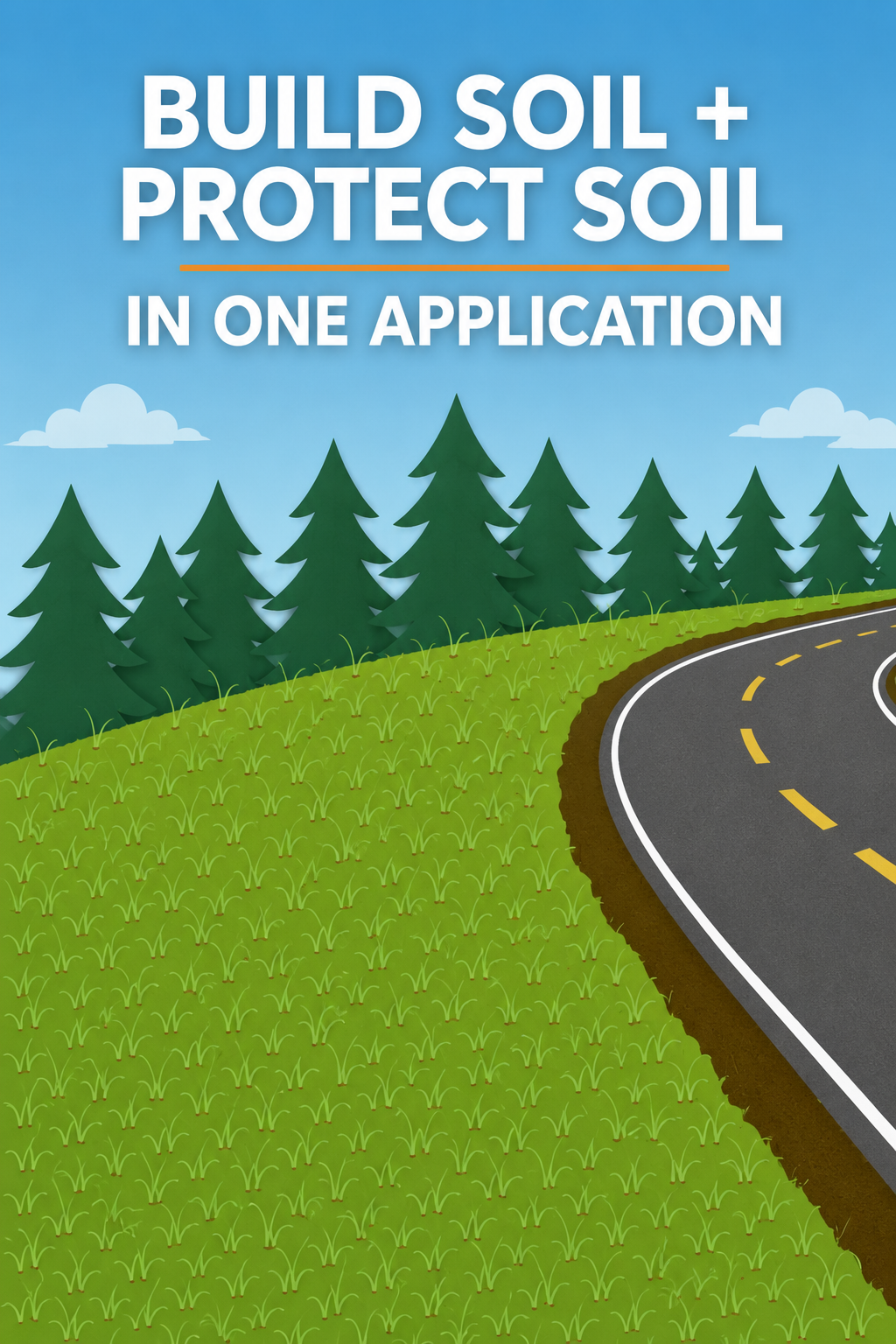
An integrated hydraulic system combines soil-building components
with erosion-control fibers in a single application. The objective
is not simply to cover the ground. It is to create the conditions
needed for vegetation to establish while reducing the risk that
rainfall and runoff will remove the treatment.
Function 01
Add organic and biologically active components that support
soil development and vegetation establishment.
Function 02
Keep the applied materials in contact with the soil rather
than allowing them to shift with wind, rainfall, or runoff.
Function 03
Form a bonded fiber matrix that absorbs rainfall impact and
helps resist soil loss during early establishment.
Function 04
Deliver soil improvement and erosion control in one hydraulic
operation instead of coordinating separate treatment steps.
Traditional project sequencing may require separate soil amendments,
erosion-control materials, deliveries, tank loads, and application
steps. An integrated system combines those objectives into one
hydraulically applied treatment.
This approach can be especially valuable on large sites, remote
locations, access-constrained slopes, and schedule-sensitive projects
where every mobilization and tank load affects productivity.
A combined system can simplify suitable projects, but it should not
replace a separate soil-building and erosion-control system where
site demands require higher performance, specialized application
rates, or independent treatment layers.
Project-specific evaluation is essential.
Final selection should consider soil test results, slope geometry,
rainfall exposure, drainage conditions, vegetation requirements,
application rates, equipment, specifications, and the consequences
of establishment or erosion-control failure.
Integrated soil and erosion control is particularly useful where
depleted soils, moderate erosion exposure, difficult access, and
installation efficiency intersect.
Treat extensive disturbed areas where separate applications
would require substantial labor, water, equipment, and tank loads.
Support vegetation on cuts, fills, shoulders, medians, and
transportation slopes with depleted construction soils.
Improve establishment on pond slopes, berms, swales, and
surrounding areas where imported or amended soil is limited.
Reduce mobilization and material handling where access is
difficult or repeated installation steps are impractical.
Reestablish disturbed soils along pipelines, transmission
corridors, access roads, and linear construction zones.
Address soil quality and erosion exposure together when
establishment progress affects inspection or project completion.
Biotic soil media and bonded-fiber erosion control in one
hydraulically applied matrix.
ProGanics DUAL is designed for projects where depleted soil
conditions and erosion exposure must be addressed together.
It combines soil-building components with bonded fiber protection
to support vegetation establishment while simplifying application.
R.H. Moore helps connect soil conditions, erosion exposure,
vegetation requirements, specifications, equipment, and field
execution before material reaches the tank.
01
Review soil characteristics, organic matter, fertility,
biological limitations, pH, compaction, and rooting conditions.
02
Assess slope geometry, rainfall exposure, runoff, access,
establishment goals, and the consequence of failure.
03
Determine whether an integrated system or separate soil and
erosion-control treatments provide the best project fit.
04
Confirm quantities, application rates, loading sequence,
additives, equipment compatibility, access, and installation.
Bring R.H. Moore the soil conditions, slope geometry, specifications,
schedule, and application constraints. Our team will help determine
whether an integrated system can reduce project complexity while
delivering the required performance.
LET’S GET TO IT TOGETHER
Work with R. H. Moore for sustainable erosion and stormwater solutions
© Copyright 2026 R. H. Moore & Associates, Inc. – All rights reserved